
How Much Food per Person: The Portion Guide
As a rule of thumb per adult: 100–125 g pasta, 60–80 g rice, 200–250 g potatoes, 150–180 g boneless meat and 200–250 g vegetables as a side — all weighed raw. Children from school age need roughly half to two thirds of that. The full table is here as a printable PDF.

Founder of TellerPlan
Yvonne is a mother of two living in Switzerland. She founded TellerPlan to make weekly grocery shopping easier for families.
The key amounts at a glance
The question comes up both in the shop and at the stove: how much do I actually need per person? Plan too little and you are passing round extra bread. Plan too much and you are throwing things out at the end of the week. Here are the numbers that get you right in both directions.
Every figure here is weighed raw and uncooked. That is the only number that helps you in the shop and at the scales — cooked rice weighs three times as much, and pasta well over double.
- Pasta: 100–125 g per adult, 60–80 g per child. For pasta as the whole main course with little on the side, go for 125 g.
- Rice: 60–80 g per adult, 40–50 g per child. It looks like nothing dry and triples once cooked.
- Potatoes: 200–250 g per adult, 120–150 g per child. For mash, count on 250 g.
- Meat, boneless: 150–180 g per adult, 80–100 g per child.
- Meat on the bone: 200–250 g per adult — the bone is on the scales, but not on the plate.
- Vegetables as a side: 200–250 g per adult, 100–150 g per child. As a main course, 300–400 g.
- Soup: 3–4 dl as a main, 2 dl as a starter.
The children's column applies roughly from school age. Toddlers need considerably less, while growing teenagers often eat as much as adults or more — for teenagers, simply plan the adult amount.
Printable portion table as a PDF
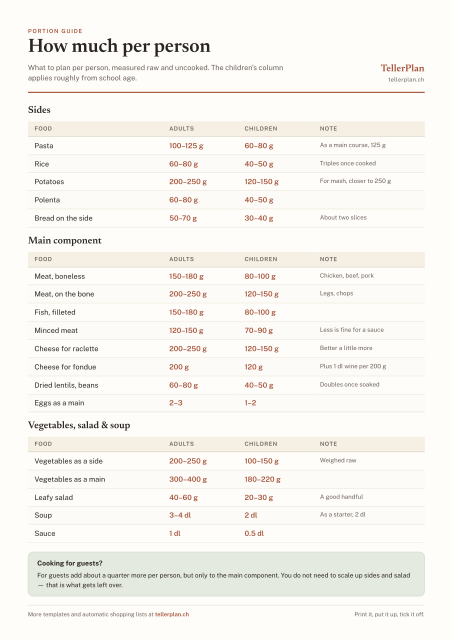
You need these numbers exactly when your phone does not appreciate sticky fingers: while cooking and while writing the shopping list. So here is the whole table on one A4 page to put up — sides, main component and vegetables, each for adults and children.
Ready to print
Portion table per person as a PDF
Every guideline amount for pasta, rice, potatoes, meat, fish, cheese and vegetables on a single page — for adults and children, weighed raw. Made for the inside of a kitchen cupboard door.
PDF · A4 · 1 page · free
Download for freePasta, rice and potatoes: the sides
Sides are where the guessing goes wrong most often, because raw and cooked are so far apart. Pasta per person is the classic case: 100 g dry looks like very little, but comes out at a good 250 g cooked. For a bake or a dish with plenty of sauce, 100 g is enough; for pasta as the sole main course, count on 125 g.
Rice is the biggest trap: 60–80 g per person sounds like nothing, but it triples during cooking. Measure out a full cup per person and you will have rice for two days. That is no disaster as long as it is planned for — yesterday's cold rice becomes today's fried rice.
With potatoes it depends on what you are making. For boiled potatoes 200 g is plenty; for mash count on 250 g, because some of it is lost in the peeling. The same goes for rosti: the peeling waste is already accounted for if you start from raw, unpeeled potatoes.
Not a fan of scales? A handful of dry pasta is roughly a child's portion, two handfuls an adult one. For spaghetti there is the thumb-and-forefinger trick: a circle of about 2 cm across is one portion.
Meat, fish and cheese: the main component
With meat, the question that matters is whether the bone is on the scales. Boneless — strips, chicken breast, escalopes — count on 150–180 g per adult. On the bone, so legs or chops, you need 200–250 g, because a noticeable share of that weight never reaches the plate.
Minced meat is the exception in the other direction: for a bolognese or mince with pasta, 120 g per person is comfortably enough, because the sauce and the side do the rest of the work. For meatballs, where the meat is the star, use the same figure as other boneless meat.
For raclette and fondue, most people plan too tight. For raclette, count 200–250 g of cheese per adult; for fondue, 200 g plus around 1 dl of wine per 200 g of cheese. With raclette it is worth planning a little extra — leftover cheese keeps in the fridge for a week without any trouble. The full list is in our post on the raclette shopping list.
Vegetables and salad: where nearly everyone under-plans
Vegetables per person get systematically underestimated. As a side you need 200–250 g raw per adult — considerably more than most people put in the pan. A single carrot per person is not a vegetable side, it is a garnish.
When the vegetables are the main event — a vegetable curry, a bake, a stir-fry with rice — the amount nearly doubles: 300–400 g per adult. That sounds like a lot, but vegetables lose a great deal of volume as they cook. 400 g of raw courgette and pepper is an ordinary plateful.
Leafy salad, by contrast, needs only 40–60 g per person, about one good handful. A whole lettuce makes three to four portions. Salad is also the item that gets thrown away most — better to buy sparingly and more often. There is more on this in our post about food waste in Switzerland.
Turning this into a shopping list
The amounts per person are half the sum. The other half is the multiplication: four people, three pasta meals in the week, makes 1.2 to 1.5 kg of pasta. On top of that, the same onion turns up in three recipes and still only needs buying once.
By hand, you work that out with the menu plan next to the portion table and write the result onto the shopping list. It takes about fifteen minutes and it works reliably.
Or you let it do the arithmetic: TellerPlan knows how many servings each of your recipes makes, scales the amounts to your family size, and merges the same ingredient across different recipes into a single line — including converting between grams and units.
Either way: once the amounts are right, the extra bread at the end of the table disappears, and so does the half-used bag of carrots that turns up in the bin a fortnight later.
Frequently Asked Questions
How much pasta per person?
Count on 100–125 g of dry pasta per adult and 60–80 g per school-age child. For a dish with plenty of sauce or a bake, 100 g is enough; for pasta as the sole main course, use 125 g. Cooked, 100 g of dry pasta comes to around 250 g on the plate.
How much vegetables per person?
As a side, 200–250 g of raw vegetables per adult and 100–150 g per child. When vegetables are the main course, such as a curry or a stir-fry, count on 300–400 g per adult. For leafy salad, 40–60 g per person is enough — about one good handful.
How much rice per person?
60–80 g of raw rice per adult and 40–50 g per child. Raw rice looks like very little but triples in weight as it cooks — 70 g becomes a good 200 g cooked. A full cup per person is almost always too much.
How much meat per person?
Boneless, 150–180 g per adult; on the bone, 200–250 g, because the bone is included in the weight. School-age children need roughly half. For minced meat in a sauce, 120–150 g is enough, since the side and the sauce make up much of the portion.
Are these amounts raw or cooked?
Every figure is weighed raw and uncooked. That is the number you need in the shop and at the scales. Cooking changes the weight considerably: rice triples, pasta more than doubles, while meat loses around a quarter of its weight.
How much extra should I plan for guests?
About a quarter more per person, but only for the main component — the meat, the fish or the cheese. You do not need to scale up sides and salad, because in practice that is exactly what gets left over.
Recipes to try


Your own recipe collection
Collect recipes from anywhere in one place: from any recipe site, your cookbook, or Cookidoo. Weekly plan and shopping list come with it.
Start your collection freeRelated Articles
Shopping · 8 min
Shopping List Template: Free Template for Switzerland
Free printable shopping list template, organised by category to match Migros and Coop store layouts. Plus: tips for the perfect weekly shop.

Shopping · 5 min
Free Printable Menu Plan Template for Families
Free printable menu plan template as a PDF: a blank weekly page plus a worked example week for Swiss families, with instructions for filling it in.
Shopping · 8 min
Food Waste in Switzerland: How to Save Food Every Day
Switzerland wastes 2.8 million tonnes of food per year. Discover how meal planning and 7 practical tips can help you reduce food waste and save CHF 500–1,000.